
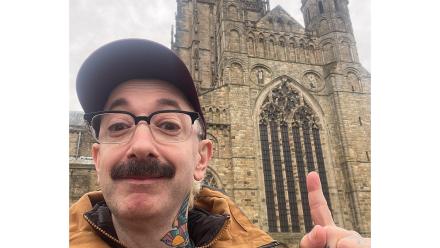
BBC Two and iPlayer’s annual Easter Pilgrimage is back for an eighth series as seven personalities of different faiths and beliefs set off across the wild landscapes of North East England. In Pilgrimage: The Road to Holy Island, the group follow a 390km network of trails, which celebrate early Celtic Christian saints while exploring their own beliefs and learning more about each other along the way.
Taking part in this unique journey are Ashley Banjo, practising Christian and leader of dance troupe Diversity; Hermione Norris, Spooks and Cold Feet actor, who believes the divine can be found in all living things; Tasha Ghouri, TV personality and atheist; Hasan Al-Habib, stand-up comedian and observant Muslim; Jayne Middlemiss, radio presenter, who self-describes as spiritual; Ashley Blaker, comedian, previously ultra-Orthodox and now a non-practising Jew; and Patsy Kensit, actor and self-proclaimed "à la carte" Catholic.
Watch Pilgrimage: The Road to Holy Island on iPlayer from 5 April.
Interview with Ashley Blaker
What were you expecting from your Pilgrimage experience?
I think a lot of walking and a lot of talking, and that was really it, because I didn't know who I'd be with. But I was excited to find out. And I guess a lot of interesting conversations with interesting people.
Did your experience meet your expectations?
We had some challenging moments, some moments that made me reflect on my own journey and probably some lasting friendships, hopefully.
Did you do anything to prepare yourself for this Pilgrimage?
I did quite a bit of walking in readiness. Quite a few hikes in the home counties to try and get ready for those Cheviot Hills. Because that's the stuff that really gets you - the elevation, going up some quite steep inclines. Those are the really hard bits. Even Ashley Banjo, who's one of the fittest people I've ever met, struggled at times. So if even he was struggling, I didn't have to feel too bad.
How did you find the mix of celebrities on the group?
It was quite interesting actually. Obviously we all got on very well, but in terms of the group, there were three younger ones and then four older ones. Three fitter, and then four of us relatively close in age in our 50s. I was comfortable among them. No one was too dissimilar in age where it felt like anyone was falling behind.
Was there anyone that you got on well with? Any interesting stories from them?
We were together for quite a long time, so it was an opportunity to have conversations one-on-one with everyone and bond over different things. Obviously we talked about those big spiritual questions, but all kinds of things. Hasan and I, two comedians, we obviously had a lot in common. I chatted a lot about being a father, which I really enjoyed with Hermione about, but also, I had a lot of long conversations with Patsy.
Was there any part of your experience that stood out? Obviously everyone comes from different backgrounds, different faiths, everyone's got a different story and a different way that they see the world. Was there anything during the journey, or anywhere you went, where somebody's views on a particular subject really stood out to you?
I think it was really interesting how different people reacted to different things. When we went to St. Cuthbert's tomb in Durham, Jayne took herself to the side and just contemplated. She did that quite a few times on her own, to think about how it felt to her. Everyone reacted in different ways like that. Hasan is always ready with a joke wherever we are. People reacted to different things, and it's surprising how some people would react to certain things. We all kind of had our moments. It's quite an arduous process, quite a long time and sometimes sharing accommodation together, three of us in a room can be interesting. Ashley Banjo is like six foot seven, so he takes up half the room himself! There were times when everyone needed a bit of quiet, or needed to just have a sit down and be apart a bit. I spoke a lot in the show about the challenges of being the only neurodivergent person in the group.
You visited a Reform synagogue, which is quite different to the Orthodox synagogue you were used to in your more observant days. Did that spark an interesting discussion between you and the other pilgrims as many people outside the religion are unaware of the different denominations of Judaism?
I think people who aren't Jewish do find it confusing, because it is confusing and it's something that people who are Jewish have lived with their whole life and understand.
When we went back to the house after visiting the Reform synagogue, the other pilgrims - Banjo and Jayne - who hadn’t joined us there wanted to hear about it. Even when I tried to explain it, I think they were still a little baffled, which makes sense. It's a baffling thing. But being Jewish is so much more than a religion. You wouldn't say "I'm Christian, but agnostic" those two things are kind of mutually exclusive. You either believe in God and Christ as the son of God, et cetera, or you don't. But lots of Jews are irreligious – they come from Jewish heritage, but not observant. So yeah, it is quite different.
You were once an extremely observant, Orthodox Jew, but now you don’t practice anymore. How would you describe this transition?
The way I describe it is quite similar to when I used to be a fanatical Liverpool supporter and used to go to every game home and away. I don't do that anymore. I don't feel the need to go to games, but I still follow it on TV. And in the same way, that's kind of how I feel about Judaism. I'm an armchair Jew. I'm happy for other people who can go to the synagogue for me. I don't need to go myself but I still have that connection, the same way I still follow the same football team.
It's something quite hard to understand. It's also such a massive part of my identity. It's all I've ever known. And it's not like I live in the heart of the shtetl (a small Jewish town or village). My children go to Jewish schools and I'm very much part of the community. You don't just shake that off. Just because you don't want to keep kosher anymore, or keep the Sabbath anymore, it doesn't change who you are.
What was the change for you from being Ultra-Orthodox to non-practising?
Just changing, not practising as much. I think that's a really hard one to boil down to a sentence, it's a whole book. But I've described it as the end of a hyperfixation.
During the series, I joked to Banjo that I completed it. And it does sometimes feel like that. I finished it. That's a little bit flippant, and there's obviously a bit more to it than that. But it is like that. It's something I did, and that hyperfixation probably went on a little bit too long. But ultimately, whatever way I describe it, the fact is that for some reason, for a long time, I needed to do that stuff - to go to synagogue three times a day, to keep all the rules and so on. And then I stopped feeling the need to do it. You know I used to go to the gym five times a week, or I used to go to every football match, and then I stopped. I just kind of didn't feel the need to do that anymore.
I'm always amazed at the people I know who go to the same synagogue day in, day out, week in, week out, year in, year out. I'm kind of amazed they don't get bored. But I suppose they've just got something that maybe I never quite had. I just got to a point where I felt I'd done it.
Did the experience make you feel more connected to your Judaism?
No. You won't be seeing me back in synagogue anytime soon. But I think if you watch back the three episodes, some of the experiences I had, not that this was ever particularly in doubt, affirmed my standing as a Jewish person. I'm certainly not going to be converted any time soon. I didn't feel anything going to places like Durham Cathedral, not that I expected to.
The quite visceral reaction I had to the Reform synagogue, affirmed it. If I had any doubt, that settled it. I'm always going to be supporting the same team. Maybe not with the same passion I used to have, but Reform Judaism feels to me like supporting Everton or Man United.
How did you find the cultural landmarks you visited? Did you feel any connection to them?
They're very beautiful. Amazing scenery, very privileged. Some breathtaking places. Durham Cathedral, for example I didn't feel any connection to it in a spiritual way, obviously, and felt quite alien to it. It doesn't feel like mine. Going into a church, there's just this feeling I did speak about it. A feeling of deep down, something within you almost fighting it, like you're not quite meant to be there. But that said, it was amazing to walk through Durham Cathedral and see St. Cuthbert's tomb and places like that.
Some of the scenery on the big walks up the Cheviot Hills were incredible and obviously then the walk to Lindisfarne, across Pilgrims Way, is pretty amazing, and the island itself is quite a spectacular place. I was privileged to have the chance to do that. It wasn't at the top of my list, but it was great that I had the chance.
What do you hope that viewers will take away from watching you take part in the series?
I think there will be viewers who relate to my experience particularly, as I talked about a lot in episode three, about the feeling of being a bit of an outsider in the group. I think other neurodivergent people might connect with the experience of struggling within a group and feeling like you don't quite fit. I think that's probably the biggest takeaway.
What are you looking forward to seeing when you watch the series?
I hope it's an entertaining watch. It’s always interesting when pilgrims speak about their own experiences. In my case I speak a lot about the Jewish thing, but even more so about being neurodivergent. It'll be interesting for me to watch it as a viewer.
How was it finally getting to the end at Lindisfarne?
I was very proud. I think I pushed myself outside my comfort zone a bit. I mean, I was the only one who did it properly everyone else kept their boots on. I rolled up my trouser legs and walked barefoot for two hours across Pilgrim’s way, which I was proud of. As a true pilgrim, if you're going to do it, do it properly. That's the story of my life. No one else would do it. No one else would go barefoot. It was very slippery, very muddy underfoot. I needed people to help me a bit. Jayne was holding my hand at one point because of how slippery it was. But we got there.
When I got to Lindisfarne. everyone else had wet feet having walked through the water - their boots were completely sodden. They were trying to dry their stuff out, walking in wet fields. And I just dried my feet and put my dry socks and boots back on. So that was great.
It was a sense of achievement. It's not like winning I'm A Celebrity or being the winner of some competition but I felt, secretly, like I'd won. I'm quite competitive, so that helped.
Would you do it again?
Oh, I'd definitely do it again. I think it's an opportunity to push myself a bit. And if I did it again with different people, all those variables will change the experience.
Interview/picture supplied by BBC


